OPRA Exam 2026 – Overseas Pharmacist Readiness Assessment Guide: The Overseas Pharmacist Readiness Assessment (OPRA) Exam is the mandatory competency assessment for internationally qualified pharmacists who wish to pursue pharmacist registration in Australia and, in certain registration pathways, New Zealand. Administered by the Australian Pharmacy Council (APC), the OPRA exam evaluates whether overseas-trained pharmacists possess the clinical knowledge and decision-making skills required to practice safely in Australian healthcare settings.
Introduced as the replacement for the former Knowledge Assessment of Pharmaceutical Sciences (KAPS) Exam, the OPRA assessment places greater emphasis on clinical reasoning, patient care, and evidence-based decision-making, rather than memorizing pharmaceutical facts. Click Here for More Details and Latest Updates
Highlights of OPRA Exam 2026
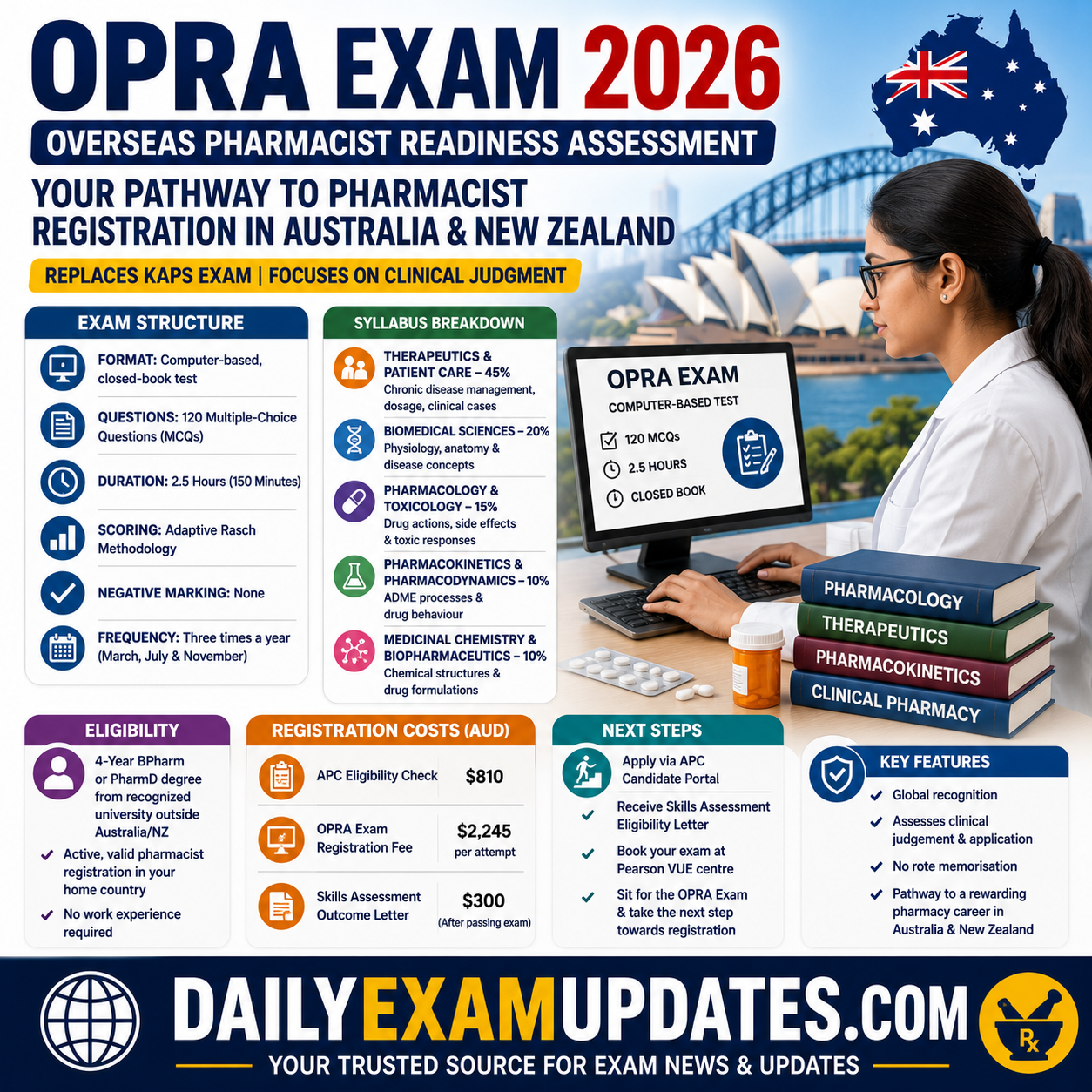
| Particular | Details |
|---|---|
| Exam Name | Overseas Pharmacist Readiness Assessment (OPRA) |
| Conducting Authority | Australian Pharmacy Council (APC) |
| Purpose | Competency assessment for internationally qualified pharmacists |
| Exam Mode | Computer-Based Test (CBT) |
| Question Type | Multiple-Choice Questions (MCQs) |
| Total Questions | 120 |
| Exam Duration | 2.5 Hours (150 Minutes) |
| Scoring Method | Adaptive Rasch Methodology |
| Negative Marking | None |
| Exam Frequency | Three times annually (typically March, July & November) |
| Testing Centres | Pearson VUE Test Centres Worldwide |
What Is the OPRA Exam?
The Overseas Pharmacist Readiness Assessment (OPRA) is a standardized examination developed by the Australian Pharmacy Council (APC) for pharmacists who obtained their pharmacy qualifications outside Australia and New Zealand. The assessment determines whether internationally trained pharmacists have the clinical competency required to continue the registration pathway toward becoming licensed pharmacists in Australia.
Unlike its predecessor, the KAPS Exam, the OPRA exam focuses on applying pharmaceutical knowledge to realistic patient-care situations rather than recalling isolated facts.Click Here for More Details and Latest Updates
Why Was the OPRA Exam Introduced?
The Australian Pharmacy Council introduced the OPRA examination to modernize pharmacist competency assessment.
The exam reflects current pharmacy practice by emphasizing:
- Clinical reasoning
- Patient-centered care
- Safe medicine use
- Evidence-based decision making
- Practical therapeutic knowledge
This updated approach better aligns with the expectations of contemporary pharmacy practice in Australia.
OPRA Exam Structure
The OPRA examination follows a consistent format worldwide.
Examination Format
| Component | Details |
|---|---|
| Mode | Computer-Based Test |
| Test Type | Closed Book |
| Questions | 120 Multiple-Choice Questions |
| Duration | 150 Minutes |
| Delivery | Pearson VUE Testing Centres |
Candidates complete all questions within one sitting under supervised examination conditions.
OPRA Scoring System
The OPRA examination uses Adaptive Rasch Methodology, a modern psychometric scoring model designed to evaluate candidate competency fairly across examination sessions.
Key Features
- Adaptive scoring methodology
- No negative marking
- Equal opportunity across test administrations
- Competency-based assessment
Since there is no penalty for incorrect answers, candidates should attempt every question.
OPRA Exam Schedule
The examination is generally conducted three times each year.
Typical examination sessions include:
- March
- July
- November
Exact examination dates are announced by the Australian Pharmacy Council before each testing cycle.
OPRA Exam Syllabus
The examination covers core pharmaceutical sciences together with clinical practice.
1. Therapeutics and Patient Care (45%)
This is the largest component of the examination.
Topics include:
- Chronic disease management
- Patient counselling
- Clinical case scenarios
- Medication review
- Dosage adjustments
- Clinical decision making
2. Biomedical Sciences (20%)
Candidates should understand:
- Human anatomy
- Physiology
- Disease mechanisms
- Pathophysiology
The focus is on applying biomedical knowledge to patient care.
3. Pharmacology and Toxicology (15%)
This section evaluates knowledge of:
- Drug mechanisms of action
- Drug interactions
- Adverse drug reactions
- Toxic effects
- Poison management
4. Pharmacokinetics and Pharmacodynamics (10%)
Candidates assessed on:
- Absorption
- Distribution
- Metabolism
- Excretion (ADME)
- Drug concentration
- Drug response
5. Medicinal Chemistry and Biopharmaceutics (10%)
Topics include:
- Drug formulations
- Chemical structures
- Pharmaceutical chemistry
- Drug stability
- Dosage forms

Eligibility Criteria
To register for the OPRA examination, applicants generally must satisfy the following requirements.
Pharmacy Qualification
Applicants should possess:
- Bachelor of Pharmacy (minimum four-year program), or
- Doctor of Pharmacy (PharmD)
The qualification must be obtained from a recognized institution outside Australia or New Zealand.
Professional Registration
Applicants should hold an active and valid pharmacist registration or license issued by the appropriate pharmacy regulatory authority in their home country.
Work Experience
- Previous professional work experience is not required to apply for the OPRA examination.
- Graduates meeting the educational and licensing requirements may begin the assessment process.
OPRA Fees
Applicants should budget for several stages of the registration process.
| Service | Fee (AUD) |
|---|---|
| APC Eligibility Check | $810 |
| OPRA Examination Fee | $2,245 |
| Skills Assessment Outcome Letter | $300 |
These fees are published by the Australian Pharmacy Council and may change over time. Candidates should always verify the latest fee schedule before applying.
How to Register for the OPRA Exam
- The application process generally involves several steps.
- Create an account through the APC Candidate Portal.
- Submit educational documents and professional registration details for eligibility assessment.
- Receive the Skills Assessment Eligibility Letter if your application is approved.
- Book an available examination session through the designated Pearson VUE testing system.
- Sit for the OPRA examination at your selected Pearson VUE testing centre.
Where Can You Take the OPRA Exam?
The examination is delivered globally through Pearson VUE testing centres. Candidates may choose an available location in their country or region, depending on testing centre availability.
What Happens After Passing the OPRA Exam?
Passing the OPRA examination is an important milestone toward pharmacist registration. Depending on your intended pathway, successful candidates may proceed with additional registration or migration requirements, including obtaining a Skills Assessment Outcome Letter, which may be required for eligible Australian skilled migration applications.
Candidates should follow the latest APC and relevant pharmacy registration authority requirements for the next steps.
Preparation Tips
Successful candidates often focus on practical application rather than memorization.
Recommended strategies include:
- Review Australian clinical guidelines.
- Practice patient-based case studies.
- Strengthen therapeutic decision-making skills.
- Improve pharmaceutical calculations.
- Complete timed practice questions.
- Familiarize yourself with computer-based testing.
Frequently Asked Questions (FAQs)
What is the OPRA Exam?
The OPRA Exam is the Overseas Pharmacist Readiness Assessment administered by the Australian Pharmacy Council for internationally qualified pharmacists.
Who conducts the examination?
The examination is administered by the Australian Pharmacy Council (APC).
Does OPRA replace the KAPS Exam?
Yes. OPRA has replaced the former Knowledge Assessment of Pharmaceutical Sciences (KAPS) examination.
How many questions are included?
The examination contains 120 multiple-choice questions.
How long is the examination?
Candidates have 150 minutes (2.5 hours) to complete the examination.
Is there negative marking?
No. There is no penalty for incorrect answers.
How often is the OPRA exam conducted?
The examination is generally offered three times each year, typically in March, July, and November.
Where is the examination conducted?
Candidates take the examination at authorized Pearson VUE testing centres around the world.
Is work experience required?
No. Prior pharmacy work experience is generally not required for OPRA eligibility.
How much does the OPRA examination cost?
The OPRA examination fee is AUD $2,245, in addition to other applicable APC assessment fees.
OPRA Exam 2026 | Overseas Pharmacist Readiness Assessment Guide
The Overseas Pharmacist Readiness Assessment (OPRA) is now the primary competency assessment for internationally qualified pharmacists seeking registration pathways in Australia. By emphasizing clinical judgment, patient-centered care, and evidence-based pharmaceutical practice, the OPRA exam reflects the evolving standards of modern pharmacy. Candidates who understand the eligibility requirements, prepare thoroughly, and follow the official APC registration process will be well positioned to progress toward their professional goals.
DailyExamUpdates.com provides simplified examination guides, licensing updates, recruitment news, and educational resources to help readers stay informed. While we make every effort to ensure the information published is accurate and current, applicants should always verify examination requirements, fees, registration procedures, and eligibility criteria through the official Australian Pharmacy Council (APC). If there is any discrepancy between our content and the official information, the official APC publications and announcements shall be considered final.
Click Here for Official Website
Click Here for More Details and Latest Updates